
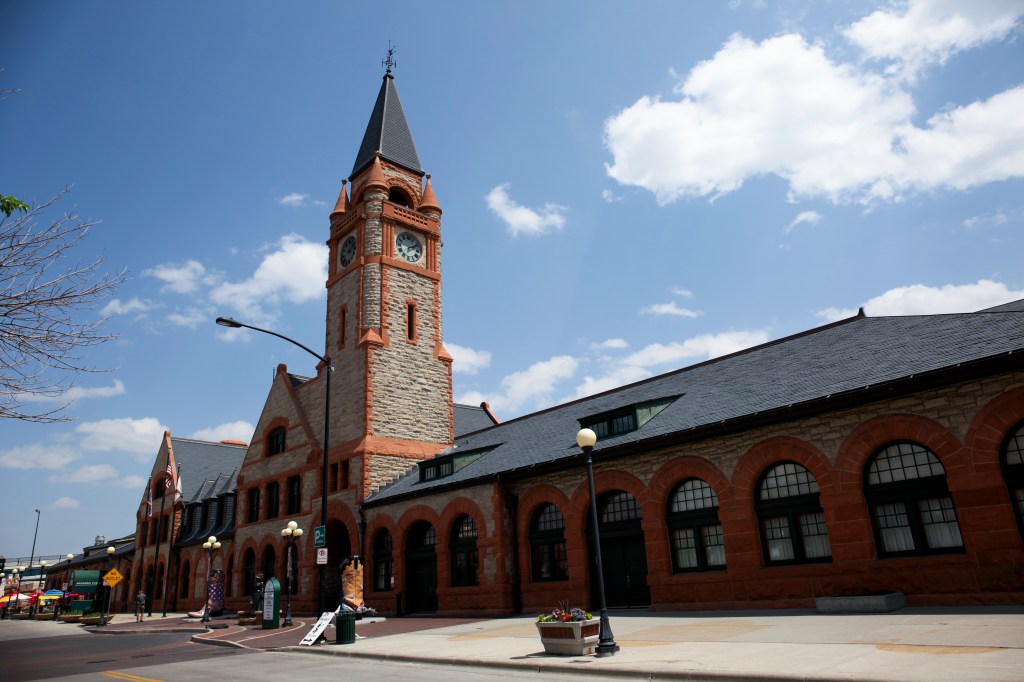
Train stations fascinate me. I love the architecture and the purpose for which they were built. These buildings make me nostalgic for a simpler time that I never experienced.
Though not extremely rare across the United States, many stations (or depots) in smaller towns have disappeared or fallen into disrepair. Many older stations along the Amtrak lines remain in use, like the beautiful station in Laurel, Mississippi. I love finding stations that still exist. The stations have architectural flare, embodying elements of the popular design movements in the late 19th and early 20th centuries (Beaux-Arts, Victoria, Gothic, Mission, Craftsman, and Art Deco). Some were grand structures constructed of stone and brick; others were smaller, less ornate clapboard structures. I photographed the beautifully majestic train depot above in Cheyenne, Wyoming—one of the nicest old stations I have ever seen.
The small train station in my hometown of Calvin, Oklahoma, was long gone before I was born, even though the town owes some of its existence to the railroad industry. I have only seen one very blurry photo of the Missouri, Oklahoma & Gulf Railroad depot and its footprint appears on insurance maps from 1899 and 1903. The town began and grew as the railroad companies built two massive bridges over the South Canadian River – one immediately north and one east of town. We used to walk across the one just north of town as kids—that was before I watched “Stand by Me” (IYKYK). Freight trains used to stop in Calvin to load cotton, pickles, and peanuts. These trains continued to rumble through town during my high school days. The trains have long since bypassed Calvin, but the two bridges remain as reminders of these bygone days.
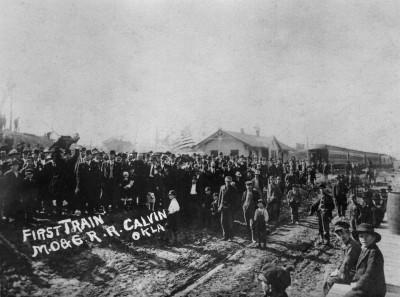
Once, these structures were hubs of activity and connection points for transportation. Trains were an equalizer that offered the freedom of mobility for the rich and poor, the urban and rural before everyone owned a car. Daily train service came to even the smallest towns in America, all at a reasonable price. The fact that trains were accessible to poor folks stands out to me since two of my grandparents grew up on tenant farms in southwest Oklahoma. Opportunity is part of the story of trains and train stations in America.
The more I investigated these stations, the more nostalgia grew. Even though trains were much less prevalent during my early years, the culture still centered around the downtowns of big and small towns. Somehow, I associated trains with this former way of life and connection—before big box stores and online shopping. As a kid, I knew our banker, grocer, shoe salesman, and my parents’ high school friends. We have lost much as small towns and downtowns have dried up, and we have expanded our range. Now, we travel on interstate highways or in jet planes with personal entertainment screens. These ways separate us from others.
I remained fixated on the positives of train travel and depots until one of the negatives hit me square in the face. The blueprints of these beautiful stations tell another story of America—one we must reckon with and understand. The stations—mostly built during the Jim Crow Era—were firmly entrenched in segregation. Most had a “white” or “general” waiting room and a Black waiting room labeled with a vocabulary of the day. In each case with segregated waiting rooms, the white waiting room was larger, and when restrooms existed, the white restrooms were larger.

Plan of the Holdenville, Oklahoma depot. Holdenville is the county seat of Hughes County, where I grew up.
I knew all this in theory. I have frequently read about Plessy v. Ferguson, the 1896 case about segregation on trains that originated in my adopted hometown of New Orleans. That case could have changed things for Black people in America. Unfortunately, the Supreme Court failed. So, in my nostalgia, I focused on the positives of train depots. Reading the blueprints hit me hard. While trains made travel available for all people regardless of economics, class, and race, the segregationist ideologies did not allow the same freedoms for all people. We face this same bitter history when we look back at schools, churches, state and local governments, transportation, and every aspect of U.S. history. Our history stings today because of these wrongs.
I still love train depots, but I understand their history differently. My nostalgia has been tempered and refined. Some things were simpler back then, but some things were not. Now, when I see a train depot, I remember not only the equalizing power of the trains but also mourn the way trains were used to divide, suppress, and control.
 garydmyers.com
Leave a comment